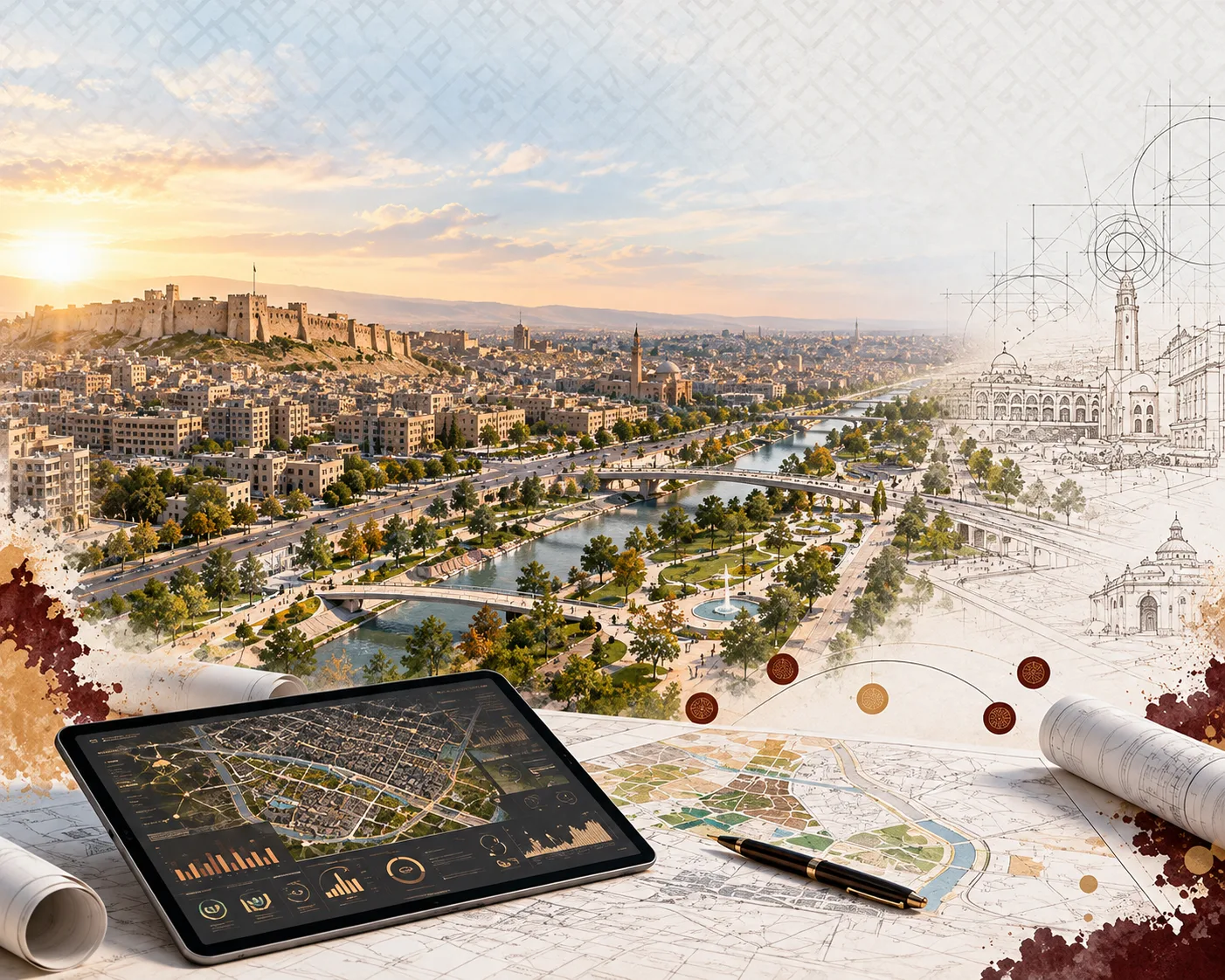
As Syria’s reconstruction and urban development needs continue to expand, urban development projects in Syria are emerging as an area where addressing urban needs can intersect with the creation of long-term investment opportunities. Yet the investment value of these projects is not determined by land area or construction scale alone. It depends on their ability to transform real needs into structured projects that can be developed, operated, and scaled over time.
Syrian cities face accumulated urban and economic challenges, including damage to infrastructure, buildings, and public facilities, alongside the need to reorganize urban spaces and develop services and economic activities.
According to a World Bank report published in October 2025, the estimated cost of reconstructing Syria’s damaged physical assets stands at approximately USD 216 billion, while estimated direct physical damage amounts to around USD 108 billion. Infrastructure accounts for approximately 48% of total direct damage.
These figures illustrate the scale of the country’s needs, but they do not mean that all reconstruction needs represent ready-to-invest commercial opportunities. Moving from need to opportunity requires identifying actual demand, assessing economic feasibility, and developing an investment and operating model capable of long-term sustainability.
This raises a fundamental question: Where is investment value created in urban development projects in Syria, and what makes such a project an investable opportunity?
Why Are Urban Development Projects in Syria Emerging as Investment Opportunities?
Urban development extends beyond the construction of buildings and real estate complexes. It encompasses the development of existing or new urban areas and sites, the reorganization of land uses, and the improvement of infrastructure, facilities, and services in ways that enhance their economic, urban, and social value.
Urban development projects may include the rehabilitation of major urban corridors, the development of mixed-use areas, the creation of commercial, recreational, and service facilities, the improvement of public spaces, and the repurposing of underutilized land and sites.
Within the Syrian context, several needs may create opportunities for new investment projects.
The first is the rehabilitation of damaged areas and the revitalization of locations that have lost part of their urban and economic functions.
The second is the development of infrastructure and urban services, including roads, facilities, and utility networks that support residential and commercial activities.
A third area involves the development of commercial, service, and recreational zones that respond to community needs while supporting local economic activity.
There is also demand for public spaces and community facilities that improve quality of life, as well as for integrated urban planning that connects housing, employment, services, and mobility.
The investment feasibility of these opportunities varies significantly from one city to another and from one location to another, depending on factors such as demand, purchasing power, the nature of local economic activity, and the availability of infrastructure.
For this reason, assessing an urban development opportunity should not begin with the size of the available land. It should begin by asking what need the project will address, who it will serve, and what economic value it can create.
Where Is Investment Value Created in Urban Development Projects in Syria?
Investment value in urban development does not come from location or land alone. It is created through a combination of interconnected factors that determine a project’s ability to attract users, investors, and operators, generate revenue, and preserve its value over the long term.
Location and Optimal Land Use
Location is one of the fundamental factors in evaluating urban projects, but it is not sufficient on its own to determine feasibility.
Proximity to major transportation corridors, economic activity centers, and residential areas can enhance a project’s attractiveness. However, converting these advantages into economic value depends on selecting the right uses for the site.
A location may be suitable for commercial activities, recreational facilities, community services, or an integrated mix of uses.
Value is therefore created by aligning the characteristics of the site with market needs rather than imposing a development model that does not correspond to actual demand.
Planning and Infrastructure
Urban planning plays a central role in transforming spaces into integrated and usable environments.
This includes organizing different activities, managing mobility, providing pedestrian routes, developing green spaces, and connecting facilities to infrastructure and utility networks.
The importance of these elements extends beyond improving the physical appearance of an area. They can increase the efficiency of land use and enhance the site’s attractiveness for economic activities.
When commercial, recreational, and service facilities are designed within an interconnected master plan, they can complement one another and provide a more integrated experience for users and visitors.
The success of this integration, however, remains dependent on the quality of planning, development costs, and expected demand.
Investment Structuring and Partnerships
A site may have promising urban and economic characteristics, yet it still requires a clear investment structure before it can become a financeable and executable project.
Structuring involves defining the project scope, estimating development costs, developing the revenue model, and allocating responsibilities and risks among participating parties.
Investment participation can take different forms, including joint ventures, equity participation, strategic partnerships, or public-private partnerships (PPPs), depending on the nature of the project and the applicable legal framework.
Partnerships are particularly important for urban development projects in Syria because of the range of stakeholders that may contribute to their development, from public entities and investors to developers, contractors, and operators.
Value is created by bringing these stakeholders together within a clear framework capable of turning available potential into an executable project.
Operations and Sustainable Revenue
The investment value cycle does not end when construction and development works are completed.
Long-term feasibility may depend on the project’s ability to operate its facilities effectively, attract users and tenants, and manage its assets efficiently.
Revenue sources vary depending on the nature of the project and may include leasing commercial spaces, operating service and recreational facilities, usufruct rights, revenue-sharing arrangements, or the sale of certain developed assets where permitted by the relevant investment and regulatory framework.
Mixed-use developments can combine multiple revenue streams within a single project, but they require integrated management and careful assessment of both costs and demand.
Investment value in urban development projects in Syria should therefore not be measured solely by what is built, but also by the project’s ability to continue delivering services, generating revenue, and maintaining its attractiveness over time.
How Does an Urban Opportunity Become an Investable Project?
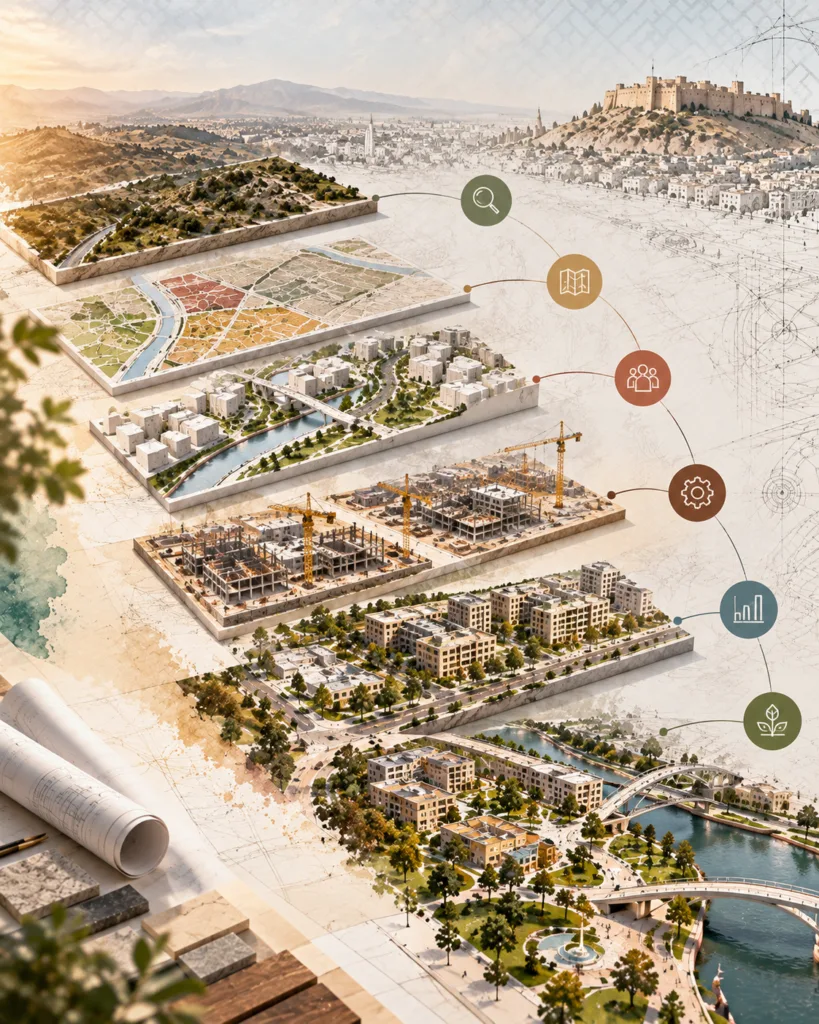
Transforming an urban need into an investment project requires moving through a series of interconnected stages, beginning with identifying the opportunity and continuing through asset development, management, and value creation.
The process starts with assessing market needs and identifying sites or activities with genuine development potential.
This is followed by project structuring, which includes assessing feasibility, determining appropriate uses, defining the legal and financial framework, and developing suitable investment and operating models.
The necessary partnerships can then be established to bring together capital, technical and operational expertise, and coordination with relevant stakeholders.
During the development stage, master plans, designs, studies, and regulatory requirements are prepared in advance of implementation and operations.
The project lifecycle does not end when its facilities open. It continues through operational performance management, service improvements, the development of revenue streams, and the assessment of opportunities for further expansion.
These stages are aligned with the value creation model adopted by Kayan Holding Group, which is based on identifying and structuring opportunities, building partnerships, developing projects, implementing and operating them, and managing and growing their value.
This model reflects the importance of approaching urban development projects in Syria as an integrated investment process rather than simply as a construction activity.
What Determines the Success of Investment in Urban Development Projects in Syria?
Despite the scale of Syria’s urban development needs, successful investment depends on a range of factors that extend beyond location and project size.
Among the most important are the legal and regulatory status of the land, ownership or usufruct rights, and the required licenses and approvals.
Projects also require an assessment of actual demand, identification of potential users or tenants, and an evaluation of their ability to access or pay for the services being developed.
Capital costs, access to financing, implementation timelines, and infrastructure readiness all influence a project’s financial feasibility.
At the operational stage, management, maintenance, occupancy levels, and revenue sustainability become increasingly important.
Within the Syrian context, these considerations take on additional significance due to economic and regulatory changes and the varying levels of infrastructure and market readiness across different cities and regions.
Urban development projects should also take into account property and occupancy rights, social and environmental impacts, and the extent to which proposed developments respond to the needs of local communities.
A successful urban development project is therefore not necessarily the largest in area or the most expensive. Rather, it is one that combines a clearly identified need, achievable feasibility, an appropriate investment structure, and the capacity for effective implementation and operation.
Aleppo Corniche: An Example of Urban Opportunity Development
The Aleppo Corniche project, being developed by Kayan Holding Group, provides an example of how urban development projects in Syria can be used to revitalize sites and public spaces within an integrated investment vision.
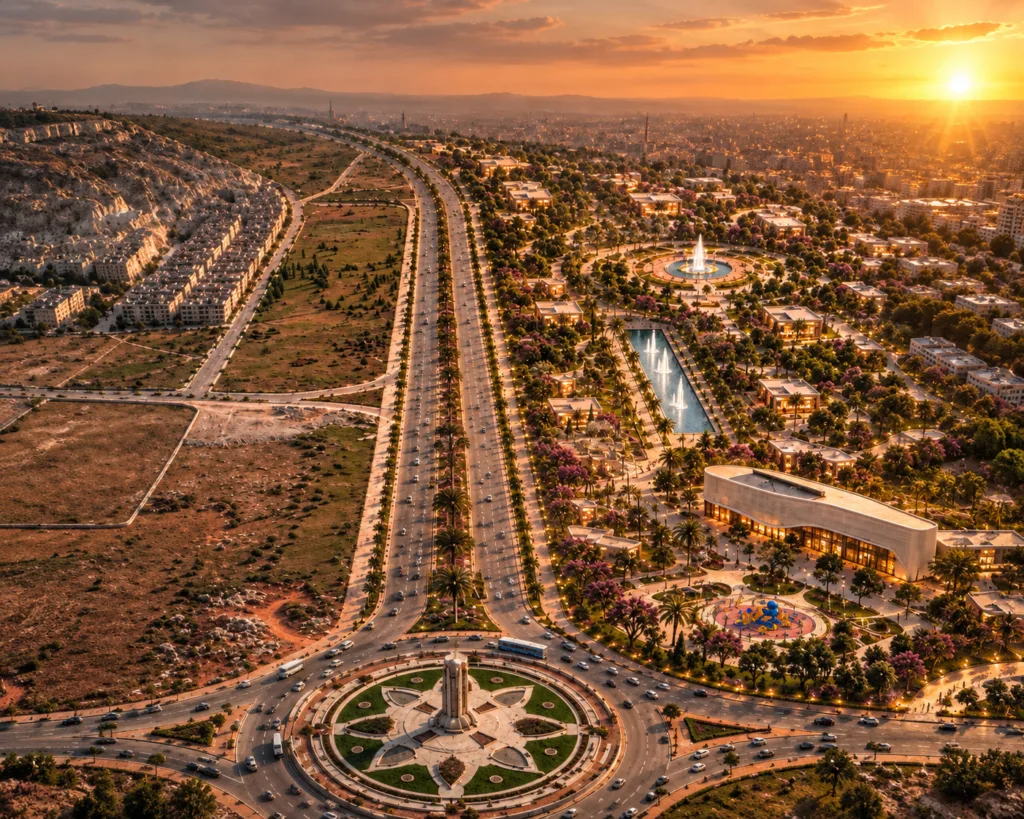
The project aims to develop part of Aleppo’s Western Ring Road through an approach that combines green spaces with recreational, sports, service, and commercial facilities.
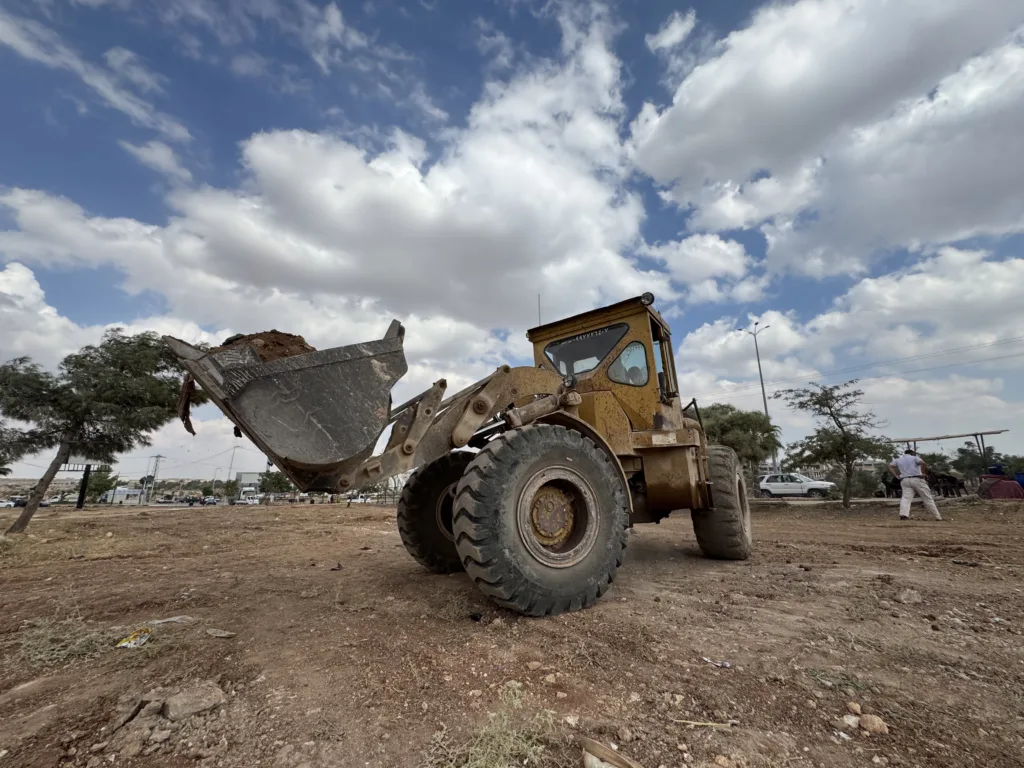
During 2026, the project progressed through several stages, including the signing of development and investment agreements, the preparation of urban plans and concepts, coordination with relevant authorities, and engineering and preparatory works.
The significance of the project lies in the nature of its location and proposed uses, combining the development of public spaces with opportunities for diverse economic, service, and recreational activities.
The project also demonstrates the relationship between urban planning and investment opportunity development. Moving from a site to an investable project requires identifying appropriate uses, developing infrastructure, structuring partnerships, and establishing an implementation and operating model.
The project’s ultimate investment value cannot be determined from plans or agreements alone, as future outcomes will depend on implementation, operations, and actual performance.
Nevertheless, the project provides a practical example of how urban and economic objectives can be brought together within a single urban development initiative.
From Developing Sites to Creating Value
Syria’s development and reconstruction needs create multiple areas in which urban development projects can be explored. However, transforming these needs into investment opportunities requires more than the availability of land or capital.
Value is created through an interconnected process that begins with understanding the market and identifying real needs, continues through planning, structuring, and partnership building, and extends into implementation, operations, management, and growth.
Within this context, Kayan Holding Group works to develop investment opportunities and build partnerships that support the transformation of promising projects into assets capable of development and operation.
Explore Kayan Holding Group’s urban development projects and discover the investment and partnership opportunities the Group is developing across Syria.